Showing posts with label Society. Show all posts

Wednesday, May 23, 2012

Feminism and Society through Melodrama and Noir

Walter Neff gazing at Phyllis Detrichson.
With noir films like Double Indemnity having such a sadistic female protagonist, can the film itself be considered feminist? Claire Johnston states, “Feminist cinema must include a challenge to the fetishistic and sadistic aspects of the scopic drive which Laura Mulvey demonstrates so convincingly.” Theorist Mulvey also pushes that the gaze in cinema, the power by men looking at and watching women, ultimately controls women. Noir contains several men “gazing,” such as Walter Neff being obsessed with Phyllis Dietrichson and staring at her constantly. That is when noir is kind; often there are scenes in which  male characters outright slap women -- or do worse. It would seem that film noir is not feminist in its approach toward women. However, noir is not truly misogynistic, though its characters might be. It is not the characters, but the politics that define the movie.
 
 Films often have a distinctive masculine or feminine appeal. This often has more to do with marketing. Masculine films could be action films, film noirs, and sports films. Whereas feminine films can be considered romantic comedies and melodramas. Without debating the semantics of masculine and feminine I wish to point out the differences between Film Noir and Melodramas, and the social commentary that they carry with them. The commentary that these two genres have upon society reflects mostly upon the gender roles of society. Both noir and melodramas reflect the poor treatment that women have in society, but they also show that in fact everyone is stuck within tight boundaries of society regardless of sex. The genres also blur the personal with the political, because both are interrelated.
 
Margarethe von Trotta, Douglas Sirk, and Rainer Werner Fassbinder are all directors of Melodramatic films, and all originate from Germany. They are considered by many to be auteur directors as well, by putting a piece of themselves into their films. Douglas Sirk was influenced by German Expressionistic cinema in his use of framing. Framing was also used by Fassbinder and von Trotta for the use of isolating individuals from the collective group representing society, or entrapping a character. Shohini Chaudhuri writes about Sirk’s influence on Fassbinder, “Sirkian influences also inspire Ali’s mise-en-scene: pools of saturated color in the Asphalt Pub scenes; the use of mirrors, doorways, partitions, and grilles to internally frame characters within the cinematic frame.”2 Von Trotta’s mise-en-scene is described then in a similar way. “Women looking through windows or waiting at windows frequently appear in von Trotta’s films at key moments in characters’ psychological development and their attempts to relate to another--a sister or a friend.” The framing techniques enhance the story being told emotionally by the filmmakers in their films. 
Ali: Fear Eats the Soul. Here we see the members of the Asphalt pub gazing at Emmi.


Here Emmi is juxtaposed so we feel her isolation against the rest of the group.


Film Noir functions much in the same fashion. The directors of Film Noir either had a background with, or were influenced by German Expressionist cinema as well as the three previously described melodramatic directors. Shots in such films as Robert Aldrich’s Kiss Me Deadly often feature a lone wolf male protagonist against the world. One shot in Kiss Me Deadly features protagonist Mike Hammer being surrounded by a large staircase. Visually, this makes us uneasy by enveloping him in a swirling image. Later we find out that he really is in over his head and caught in the middle of a political storm much bigger than he is. Here is another character who sets out into the world, only to be enveloped by it.
 
Both Melodramas and Film Noirs feature protagonists that are trying to live by their basic wants or moral codes but find themselves in some way up against society. Chaudhuri states that Sirk’s “melodramas gave Fassbinder a model for making films that could perform ‘a moral critique of an immoral society’” In the concepts of the individual against society, and society’s moral corruption, we come to the point where these two genres mix and engage. Not every Film Noir or Melodrama has societal commentary that is a conscious effort by the filmmakers. Nor do Film Noirs and Melodramas all have the same commentary.
 
However, regardless of the filmmakers’ intentions, many Film Noirs and Melodramas comment on gender issues. We see this with the femme fatale in noirs, and by the use of a repressed female protagonist in melodramas. Both types of characters can be described in many cases as a female individual who is trying to advance or get ahead in the world on either a grand or micro scale. The femme fatale does so by unscrupulous methods and is therefore ultimately punished. Whereas the melodramatic female character receives societal punishment at some point, she is  sometimes also rewarded by a deux ex machina.
 
Such an ending occurs in Sirk’s All That Heaven Allows, so that we gain the catharsis of the protagonist’s happy ending, but we acknowledge that only by an act of God was this allowed to happen in a morally bankrupt society. Fassbinder took it further by taking out the cathartic ending. Chaudhuri writes, “He designed his films’ closures to create another ‘ending’ in the audience’s head-to make it obvious to them that they must change their lives, even if society restricts their choices.”4 In either case the films are designed so that on some level we are aware of societal flaws and attempt to change them. Noir can also draw attention to societal troubles, Double Indemnity is conscious of the fact that Phyllis Dietrichson somewhat manipulated by society to the point she becomes a cold blooded murderer.
At the end of All the Heaven Allows Jane Wyman ends up with Ron Kirby. Yet the mise-en-sene of this scene makes her feel trapped. She is on the inside looking out, and the window serves to act as prison bars. So while it is a touching scene, it also becomes social commentary on the woman's place in society.
The background of the German melodramas and film noir show common similarities. Both are deeply rooted in a postwar atmosphere. Von Trotta and Fassbinder work in family histories that are related to the rise of the Nazi party. To them family history and the rise of the party are rooted in both the personal and the political. “Von Trotta views the political and social reality of postwar and contemporary Germany through the lens of personal relations and family dramas. For Fassbinder, too, politics and power relationships begin at home and are negotiated in interpersonal relations rather than in abstract political debates or historical conflicts.” In noir heroes are often returned war veterans trying to find their place back home. Often they cannot find their place. The world has changed, and it no longer needs them. Paul Schrader states that in this world, “one finds that the upward mobile forces of the thirties have halted; frontierism has turned to paranoia and claustrophobia.” In both melodrama and noir there is an overriding sense of pessimism for the world and mankind.
 
In Mariane and Julianne the two sisters become separated by political views. As they separate ideologically, they become separated physically as well. After one's arrest they are separated by a window and can no longer touch. In another a reflection of one moves over the face of the other, but as soon as it is aligned it disappears off the glass, representing their movement from each other.

Pessimism arises because it points to the fallacies of the world and attempts to get us to create change. While violence and the male gaze occur in the movie, viewers should not allow them to distract from the overall message of the film. Summing up Fassbinder’s thoughts Chaudhuri states, “‘the cultural representations through which we see and are seen’ should be the focus of our political struggle, not the gaze.” The message of the film should be at the forefront when viewed, because events that occur in the film exist to support the message. The message is political, going back to von Trotta’s view of the interrelation of the personal and political. Many noirs and many melodramas are very feminist in their politics, but are aimed at different audiences. I enjoy both and find them entertaining, because they portray similar outlooks of society.

Bibliography:
Chaudhuri, Shohini. “Ali: Fear Eats the Soul." Film Analysis: A Norton Reader. Ed. Geiger, Jeffrey and Rutsky, R.L. New York: W.W. Norton and Company, 2005.
Haynes, Todd. Far from Heaven, Safe, Superstar: The Karen Carpenter Story; Three Screen Plays. New York: Grove Press, 2003.
Johnston, Claire. “Classic Hollywood Cinema.” Movies and Methods Volume II. Ed. Nichols, Bill. University of California Press: Berkeley and Los Angeles, 1985.
Rueschmann, Eva. “The Politics of Intersubjectivity.” Sisters on the Screen. Philadelphia: Temple University Press, 2000.
Schrader, Paul. "Notes on Film Noir." Film Theory and Criticism. Ed. Braudy, Leo and Cohen, Marshall. 7th ed. New York: Oxford University Press, 2009.


*Note: It should be noted that both Noir and Melodramas had a deep influence by the German Expressionist film movement. Sirk himself came from that background, as well as several other directors and cinematographers of the time. I failed to mention this in the text, and it bears an important part explaining the style similarities of the two genres and their social commentary.

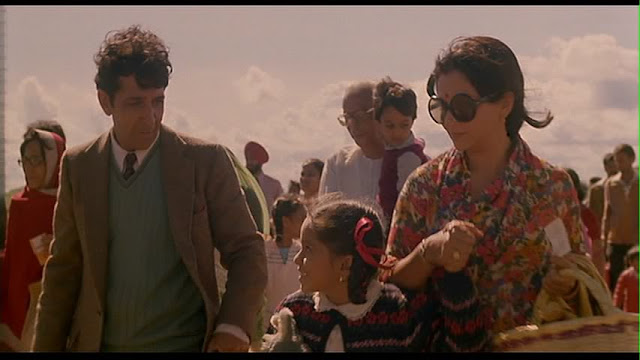
Culture in Mississippi Masala

http://www.imdb.com/video/screenplay/vi513212697/
Indians and all non-native Africans were forced out of Africa. The film raises questions about racism, what is a home and what is a native?
Mississippi Masala serves as a general human tale of love, loss, and friendship. It does so using a romantic identity, sometimes falling into the melodramatic a little. This format helps to draw us into the film, and relate to it on an emotional level. The movie unfolds like any other basic romantic story in which boy meets girl, boy loses girl, and the two end up together in the end. The story has more significant meaning than just that, however. Meena is an Indian girl who falls in love with Demetrius, a hard working carpet cleaner who is African American. They have cultural clashes as they date, but ultimately they feel that culture should not define them or their relationship. It also tells the story of Meena’s father, Jay, as he seeks penance from the Ugandan government which he feels has wronged him. The story acts as a parable for intolerance and racism in our times; and shows that racism, the act of disliking someone based off of their ethnic background, is not limited to strictly Euro-Caucasian. Identity plays a big part in the unfolding of the story of Mississippi Masala, in that the two characters have strong ties to their cultures which have helped to form their identities. The movie shows an important element of identity, which is that to find ourselves we have to distance ourselves from our cultural selves to see ourselves as we really are.

    Mississippi Masala is set in rural Mississippi. Meena and her family are descendants of Indian culture. Her parents had made their home in Uganda until all non-Africans were told to leave. They moved to England and ultimately Mississippi. Demetrius is African American, and he works hard to be financially independent while all his friends are goofing off or trying to make it big in southern California. He and Meena both have strong cultural identities, but as they fall in love with each other their cultures come into conflict. Meena’s parents do not like Demetrius; there is the underlying problem that he is not Indian. Then Demetrius’s friends and family are concerned because of how “they” – Indians -- are with “our people.” The movie shows how racism is not limited to white people, but is a cross-cultural problem.
 
 The movie Mississippi Masala shows realistic images of two distinct cultures in the film. Robert Stam and Louise Spence write about how many cultures are negatively stereotyped in several films. Then Hollywood overcompensated with “positive images” of cultures in which characters seemed too good to be true, and more often than not were. “A cinema dominated by positive images, characterized by a bending-over-backwards-not-to-be-racist attitude, might ultimately betray a lack of confidence in the group portrayed, which usually itself has no illusions concerning its own perfection.” This became another form of racism, and stereotyping in Hollywood. In Mississippi Masala we are given a more realistic look at an Indian culture relocated in America, and at a Mississippi African American community. This realism shows them in both positive and negative lights. However, it should be noted that many of the white folk in the film are shown as backwards hicks who cannot tell Native Americans from Indians and drive around in pickup trucks with American flags in their back windows. This could be deemed unfair stereotyping, but since this is a reversal of traditional cultural roles in film, and I found it funny as white male, it should be allowed to slide in this movie. On the other hand, Mississippi Masala does a fair job in presenting Indian culture, which is typically portrayed in a stereotypical fashion in American films.

    Key to the idea of culture is that of identity. Culture stems from our identity, because it is “inherited memories” we have gained from our ancestors passed down to us. Stuart Hall explains, “‘Cultural identity’ in terms of one, shared culture, a sort of collective ‘one true self’, hiding inside the many other, more superficial or artificially imposed ‘selves’, which people with a shared history and ancestry hold in common.” In Mississippi Masala we see this with both families. At Demetrius’s family dinner we get to see everyone gathering around their grandfather for his birthday, talking about growing up together. We see this also with Meena’s family, at the wedding and other various random family get-togethers in which they celebrate with their native India’s customs. Despite the fact that they are in America, and attempt to fit in, they still actively practice their religion, which many of the locals deem foreign.

    Hall continues with a second position on identity, “As well as the many points of similarity, there are also critical points of deep and significant difference which constitute ‘what we really are’; or rather -- since history has intervened -- ‘what we have become.’”2 That is to say, yes we share a social and cultural identity, however, we have an identity outside of that which is defined by our own individual words and actions. Demetrius in the film is shown against the backdrop of his culture, in which many of those amongst his age are just hanging out, and loitering the streets. He stands out because he works hard with his rug cleaning business and takes his life seriously. Meena breaks away from her family heritage by running away with Demetrius, giving Meena an identity away from her culture as well. They both look outward to define themselves, not allowing culture to define themselves.

    Despite the movements that Meena and Demetrius have undertaken to be with each other, they still have personal problems that delve into the realm of politics. Hall continues, “The past continues to speak to us. But it no longer addresses us as a simple, factual ‘past’, since our relation to it... It is always construct through memory, fantasy, narrative and myth. Cultural identities are the points of identification, the unstable points of identification or suture, which are made, within the discourses of history and culture. Not an essence but a positioning. Hence, there is always a politics of identity, a politics of position, which has no absolute guarantee in an unproblematic, transcendental ‘law of origin’.”3 The movie moves into the political realm, when we watch Meena’s relatives try to kiss up to Demetrius after the car accident. They want to get assurances that he will not sue. Then after he sleeps with Meena, they quickly turn on him by stopping all business with him to guarantee that he will no longer have contact with Meena. The scandal goes so far to lose even an actual political client, and sends Demetrius broke to the bank.

    The politics are most in the forefront with Jay, who is suing the Ugandan government for his personal loss of property, and what he feels was an illegal eviction from what he considers his homeland. Jay and Meena were not born in India like some of their relatives, but they were born in Uganda. Meena left while she was a child and has little attachment to it, whereas Jay feels that Uganda is a large part of his culture and identity. In a flashback we see him playing as a boy with another Ugandan boy, and his mother calling the two of them together “brother.” While they are probably not biologically brothers, this goes to serve the idea that identity can be based on land, not just blood, as with the case of Jay. Throughout the movie he spends most of the time being bitter. Through flashbacks we see him with his native Ugandan friend, Jammubhai, undergoing the regime change and Idi Amin kicking out non-native Africans. Jay feels betrayed when his friend Jammubhai tells him in order to help him leave and thereby save his life that “Africa is now for Africans.” Jay is hurt because he feels that despite his cultural heritage he himself is African; he was born and raised there. Rather than see his friend’s words as friendly advice, it makes him angry and bitter towards him and Uganda. Hence Jay sues the government of Uganda.

    When Jay finally gets the government to hear his case and he returns to Uganda he looks up his friend Jammubhai only to discover that he had died years before. The news is such a shock to him that he breaks down emotionally. He realizes that his anger blinded him from continuing correspondence with a person that he considered his brother. This epiphany helps Jay to realize that suing the Ugandan government will not give him justice, nor will it bring back his friend, or give him the thing he realizes is most important of all -- happiness. Jay’s adventure is a parallel with Meena and Demetrius’s love story. The two lovers could have had a falling out, and began to, but in the end overcame those fears, so that they could have love and be together. Jay did not take the step to overcome his fear and anger, and lost his friend.
Jay revisiting his homeland, and gaining a greater realization.
    It through the journeys that Meena, Demetrius, and Jay all go through that they find themselves. They have to distance themselves from their culture to look inward and to see that they are more than what their community would have them be. Demetrius’s friends told him not to go after Meena, even though she made him happy. The same with Meena and her family. When they overlooked the opposition that their communities gave them to run away together they became happy. The greater story is Jay’s acknowledgement that he should look after his own daughter’s happiness and not fight to preserve the cultural heritage if it means destroying the happiness of those he loves. This catharsis in the end of the film then becomes ours, the audience’s. It seems so trivial to fight for something that isn’t real, but is just an abstract concept that we have kept alive.

1 Spence, Louise and Stam, Robert. “Colonialism, Racism, and Representation: An Introduction.” Film Theory and Criticism. Ed. Braudy, Leo and Cohen, Marshall. 7th ed. New York: Oxford University Press. 2009.
2 Hall, Stuart. “Cultural Identity and Diaspora.” Identity: Community, Culture, Difference.    Edited by J. Rutherford. London: Lawrence & Wishart, 1990. 
3 Hall, Stuart. “Cultural Identity and Diaspora.” Identity: Community, Culture, Difference.    Edited by J. Rutherford. London: Lawrence & Wishart, 1990.

Thursday, May 10, 2012

Hello (The Long) Goodbye


Robert Altman’s the Long Goodbye dances the line of paying homage to noir and parodying noir. Modern audiences would consider it more homage, whereas a film like The Big Lebowski would be considered more of a parody. The Long Goodbye follows Phillip Marlowe as he tries to comprehend the apparent suicide of his friend, Terry Lennox, following the murder of Lennox’s wife. Many of the elements of a classic noir are there; the police are no help to him, the mob comes in for a debt from Lennox, a crooked doctor comes in, and there is a form of a femme fatale; but the film never fully fits into the noir box. In The Long Goodbye Marlowe is described by Altman as “Rip Van Marlowe”; meaning that it is as if Marlowe just woke up from the classic noir period and goes about his business. We watch in the film a person who is a moral relic of a bygone era, and Altman plays with this idea throughout the film. The Long Goodbye becomes its own sub-genre, neither homage nor parody to the films of a bygone era.

Here you can get a hint of the bleached out look of the film.
   Though the film technique is not like that of classic noir - such as complex mise-en-sene, dark shadows, low key lighting, low and high shots; the film still retained some elements of classic noir. Naremore highlights stylistic differences when he says, “In place of carefully framed, angular compositions, it uses a roving, almost arbitrary series of panning and zooming shots that continually flatten perspective.”1 Noir is often described as being confusing, slow, and dreamlike, and in the Long Goodbye I felt these elements were retained. The dreamlike quality comes from obviously its slower pace, but also the fact that the film itself is bleached out. Altman said “I wanted to give the film the soft, pastel look you see on old postcards from the 1940s.”2 This makes the film feel like a forgotten memory one recalls in their dream. At times the film felt as if it were going nowhere, with several plot lines that I thought would never be tied up. I have faith in the plot structure of classic noir that their plots will be tied up, regardless of how convoluted they are. I suppose due to the chaotic nature of Altman films, I gave in to the complexity and felt that the subplots only loosely tied together through theme, and seldom wrap up together in the end. My initial confusion was probably also tied into the slow nature of the movie, wherein I felt frustrated with Marlowe’s slow attempt to solve his friend’s murder, and the characters that I initially felt were unrelated to the central problem, and that their problems took him further from the truth. However, Altman’s approach toward a noir detective story made me forget that everything ties together, and most loose ends are solved.
Here is Elliot Gould as Phillip Marlowe.

 Elliot Gould plays Phillip Marlowe in The Long Goodbye. Marlowe’s friend, Terry Lennox, tells Marlowe that he is a born loser. Perhaps that’s why not every loose end is tied up at the end. Marlowe points out the fact that his cat runs away, and he never did find it at the end. Altman was trying to make a point here about the morals and times of the past through the use of Marlowe. Elizabeth Ward wrote, “The film noir protagonist had steadily lost any ability to effect change in a modern world, and this increasing powerlessness is correlative of diminishing social morality.”3 Marlowe does not stop any corruption or evil from occurring. When the gangster Marty Augustine smashes his girlfriend.s face Marlowe just watches, and when the novelist Roger Wade walks into the ocean and drowns, Marlowe cannot find Wade in the water to save him. Humphrey Bogart played Marlowe with swagger and a cool edge; it could be said of Gould’s Marlowe that he is more passive. Gould passively watches and asks questions, but the only action that he takes is in the end is when he finds his friend Terry and shoots him for his betrayal.
Marlowe being a wise guy with the police by putting finger ink all over his face.
    Gould’s portrayal in many ways is in contrast with Raymond Chandler’s original version of Marlowe. Naremore points out that Marlowe is “a mumbling private eye who incessantly talks to himself.”4 Gould’s Marlowe does talk a lot, constantly throughout the film making smart-aleck remarks. Not every line is gold, but I enjoy a character that says what he wants to despite his surroundings, as shown in scenes in the police interrogation room and when Marlowe is held at gunpoint by the mobsters. Despite the fact that he is under pressure or in physical danger he cracks wise, perhaps as a way to deal with pressure. At times Marlowe is painful to watch because I had no idea why he didn’t speak up directly to those around him. Bogart’s Marlowe gives the impression that he is almost always has some upper hand or that he is confident enough to get the job done. That doesn’t come across as well to me with Gould’s portrayal. Although Gould does not seem to have Bogart’s confidence, his is a more accurate portrayal of a person solving a mystery. He is swimming up the creek without a paddle, with several other components in play that either purposefully or mistakenly lead him away from figuring everything out.

Is Eileen Wade a Femme Fatale? 
   The themes of corruption and misogyny that often shown in classic noir exist in The Long Goodbye, although shown differently than in classic noir. Naremore states that “the coke-bottle attack and the running gag about the stoned, bare-breasted girls who live in an apartment across from Marlowe-seem designed to exploit a new style of misogyny and violence under the cover of a smugly superior attitude toward private-eye stories.”5 The police are portrayed differently in the film too, where many film noirs portray police as being corrupt and greedy. Ward, however, states that “the ‘modern’ corruption of the police in The Long Goodbye is not caused by individual ambition and greed but by overload and burn-out.”6 We can look at these statements and make a number of assumptions: that our viewpoints on corruption and misogyny have changed including their starting factors, or that the methods in which that they are displayed have changed.

    Altman’s the Long Goodbye contains many of the elements of noir, but like many neo-noirs never fully embraces all the elements. Times had changed, and the filmmakers and their techniques had changed with them. Altman wanted the film to look like a faded postcard, a forgotten memory, as opposed to noir’s highly stylized and graphic shots. While the world became more effective in fighting crime and became more feminist, corruption and misogyny still lingered. Maybe due to the serious nature of the content in The Long Goodbye, it can’t be taken as parody, but because of Marlowe’s attitude throughout the film it can’t be taken seriously either. Personally, I wish that more films would dance the line of humor and seriousness. However, as we see with this film, audiences often have trouble distinguishing between the two. So The Long Goodbye becomes neither homage nor parody, but stands on its own as a different kind of noir.

1.) Naremore, James. More than Night: Film Noir in Its Contexts, Updated and Expanded Edition (Kindle Locations 2654-2655). Kindle Edition.
2.) Altman, Robert, and David Thompson. Altman on Altman. London: Faber and Faber, 2006.77
3.) Ward, Elizabeth. "The Post-Noir P.I.: The Long Goodbye and Hickey and Boggs" Film Noir Reader. Ed. Silver, Alain and Ursini, James. 8th ed. New York: Limelight Editions, 2006. 237
4.) Naremore, James. More than Night: Film Noir in Its Contexts, Updated and Expanded Edition (Kindle Location 2654). Kindle Edition.
5.) Naremore, James. More than Night: Film Noir in Its Contexts, Updated and Expanded Edition (Kindle Locations 2665-2666). Kindle Edition.
6.) Ward, Elizabeth. "The Post-Noir P.I.: The Long Goodbye and Hickey and Boggs" Film Noir Reader. Ed. Silver, Alain and Ursini, James. 8th ed. New York: Limelight Editions, 2006. 240

Thursday, April 5, 2012

Gilda: The Singing Dancing Noir Heroine


"Sure, I'm decent."
Gilda is both interesting and terrifying to watch for the relationships the characters carry with each other. Johnny starts off as the narrator, but then by the end almost becomes the villain. The love triangle between Johnny Farrell, Ballin Mundson, and Gilda suggests relationships both of love and of doom, as is the case of Ballin. Through mere suggestion we question the nature of relationship between Ballin and Johnny, whom are extremely close. Then there is the sadomasochistic relationship between Johnny and Gilda. She walks and talks like a femme fatale, but she rises beyond being one by being sympathetic and relatable. In the 1940s it was traditional in films to show women in housekeeping roles; except in film noirs, wherein women who rebel against patriarchy would be punished. In the noir world women were not allowed to get ahead, or be freed; they were to be controlled. Gilda becomes unusual because of it’s portrayal of the title character in a different light; trying to promote herself, exhibiting herself in sexually, yet Gilda is depicted as being sympathetic. Gilda is more optimistic in the film world. Gilda is not a femme fatal, and she is able to persevere through her afflictions and come out the better for it.

Gilda is represented in strange ways. One of Ballin’s rules is that the club should be filled with men and unattractive women, so that Ballin can further control the gamblers by forcing their focus on gambling. With her appearance, Gilda disrupts the focus, redirecting it to herself. She is an exhibitionist, daring to challenge the authority of men over her body, by singing and dancing. Ballin has the rule that woman and gambling do not mix; however, Ballin when confronted by Johnny Farrell with this rule responds, “My wife does not come under the category of women.” Ballin may perceive and be attracted to Gilda for the fact that her behavior is masculine rather than feminine. There is an implied homosexual relationship between Ballin and Johnny. With that in mind it would be safe to assume the thing that attracted Ballin to Gilda would be her femme fatal like behavior. Femme fatales in noir is that they try to act like men rather than be servants of men, so is this could be the element that attracts him toward her. Gilda, the character in the movie world and the movie in our world, becomes a challenge toward patriarchal society. Richard Dyer writes that “The casting of Hayworth as Gilda gives the character a positive charge (where femme fatales are usually negative, in the sense of being absent in terms of personality, mere functions or the eternal unknowable.)”
. What becomes the strangest part of Gilda in the film noir universe is that she becomes sympathetic. Instead of a femme fatal sent to castrate the men, she becomes a woman fighting for her own happiness and freedom from those who are continually trying to control her.

Much of the uniqueness of the character of Gilda is created by Hayworth, the actress who played her. Other noir films had to get smaller actresses to perform due to small budgets; however, Gilda was not a B picture and therefore could afford a name actress. Rita Hayworth brought her charm to the performance of Gilda. Dyer writes about in the 40‘s Rita was considered a ‘love goddess’ for heterosexual men, but she was also “an identification figure for heterosexual women.” Dancing, he explains, was unnecessary for the character but was there because Hayworth was known for dancing. Dyer continues, “They introduce a new element into the construction of the character as a sexual object -- namely, movement.” The elements of dancing, movement, singing, and exhibitionism are all important to understanding the character Gilda, and her relationship with Johnny. He is always trying to control Gilda, not allowing her to dance, sing, or move freely. 

Johnny is punishing her, we are never told directly why and it becomes irrelevant.  Naremore probably best explains the noir hero by stating “In many cases, the noir protagonist's ability to serve as a role model is undercut by his quasi-gay relationships with men, by his masochistic love affairs with women, and by his more general weakness of character.” 
The extremes that Johnny goes to can not be justified in his treatment toward Gilda. In terms of plot development, the Nazis could have been interchangeable with gangsters. Nazis become a symbol of Johnny and Gilda’s relationship in the film and a reminder of the extremes of controlling people, allowing intolerance and hatred to blind people as it did Johnny. Johnny becomes a dictator in his treatment of Gilda, and her apartment, which he never visits, becomes her prison, from which she is never allowed to leave. After she runs away and is told that it is safe, she realizes that it was all a ruse, she was never safe. Though Ballin tries to kill Johnny and Gilda at the end, he never quite succeeds in behaving more outrageous than Johnny. He is controlling of Gilda even when she is married to Ballin, and forces her to play the good wife to Ballin. Motivations could stem from revenge against her, or that he wants Ballin to be happy and have an obedient and good wife, because of his feelings toward Ballin. Both of which could be true but it never really matters. Johnny feels threatened in the end by Gilda and that is why he treats her the way that he does. Angela Martin said, “she doesn’t necessarily have to kill or harm anyone, she just carries the threat by her very presence.” This better explains the reasoning of Johnny’s behavior. Johnny runs the casino with his own Gestapo, and treats Gilda with the hatred and intolerance that a dictator has for minorities, because he feels she is a threat by being there.

Here Gilda is caught dancing with another
man, and Johnny has come to pull her away.
Gilda refuses to allow herself to be controlled. She puts up with the cruelty Johnny gives her, perhaps, more than most would. Through it all she dances, she sings, she owns herself and refuses to be owned by Johnny, by keeping her movement free. While Hayworth was a pin-up model, and a sexual fantasy for men, there is a feminist element of freedom with her in this role. Dyer wrote “the particular kind of movement, the association with it of Hayworth’s image, its narrative placing, all make it possible to read Hayworth-as-Gilda... in Marjorie Rosen’s terms: ‘for the first time a heroine seemed to say, “This is my body. It’s lovely and gives me pleasure. I rejoice in it just as you do”, or else in terms of male heterosexual enjoyment of the character - of surrender rather than control.” An element of male masculinity in film noir and Gilda becomes about control, as Johnny controls Gilda.

Another difference between Gilda and other film noirs is everything gets straightened out, for the most part, and ends with a more traditional happy ending. Instead of being punished in the end, Gilda is rewarded. Johnny changes, acknowledges his wrong-doing against Gilda and asks for her forgiveness. Ballin, the only person standing between them and won’t let them go, gets killed. The two go off together away from the casino and the Nazis. While the change of Johnny is presented logically, with Uncle Pio and Detective Maurice Obregon appealing to Johnny to be more sympathetic and reasonable throughout the film, but the transformation is still quick and magical. Not surprisingly, some of the writers were women, and perhaps that is why this stands out as a more pro-feminist film. So the writers could have been trying to appeal to men to drop misogynistic behavior and live harmoniously with their female counterparts.

Johnny fights Nazis and cops who want to control him. Johnny even fights off luck. Then he ends up trying to control Gilda. Why should Gilda be any more controlled than he? Film noir exemplifies masculine behavior, and Gilda’s plea is to allow the Gildas of the world to continue to sing and to dance. Gilda is not a femme fatal because she is not one sided, and she becomes sympathetic. Gilda is free because of her movement. She sings and dances, and refuses to allow herself be controlled. Unlike many film noirs female characters, Gilda becomes a role model for women.

1 Dyer, Richard. ‘Resistance Through Charisma: Rita Hayworth and Gilda.” Women in Film Noir. Ed. Kaplan, E. Ann.British Film Institute. 2008. 119.
2 Dyer, Richard. 120
3 Dyer, Richard.

4 Naremore, James. More than Night: Film Noir in its Contexts. University of California Press, Berkeley and Los Angeles. 2008. Ebook edition.
5 Martin, Angela. ‘Gilda Didn’t Do Any of Those Things You’ve Been Losing Sleep Over!’: The Central Women of the 40s Film Noirs.’ Women in Film Noir. Ed. Kaplan, E. Ann.British Film Institute. 2008. 208.
6 Martin, Angela. 208.


Wednesday, March 28, 2012

Sequoia Sempervirens of "Vertigo"


SPOILER ALERT: If you haven't watched Vertigo already, do not read on.

In Vertigo, Scottie and Madeleine escape up to Muir Woods to look at the redwood trees together. The sequence is powerful not just because of the beauty of the redwoods, but because of the overpowering nature of them. Scottie and Madeleine, who is really Judy, are reduced as figures into small mammals in comparison to the sequoias. Madeleine projects her fear of death and the unknown. Scottie tries to comfort her and get her to open up, but gets pulled further into Madeleine’s lies. The feeling is of despair and hopelessness for the two characters; though they are together now, there are forces suggested ripping them apart. Those forces are the implied; through a ghost story told by Gavin and Madeleine Elster that Scottie begins to believe, and the truth that Gavin Elster has hired a doppleganger to be his wife and mislead Scottie as part of his plan to kill his wife. This sequence conveys the treachery of Scottie’s friend Gavin setting him up, Judy impersonating Madeleine to mislead him, and at the same time the supernatural happening which is all part of the set up.


Hitchcock’s use of mise-en-scene projects this sense of disparity and hopelessness in the forest sequence. The trees are huge and majestic, overpowering the image of the screen. Andre Bazin illustrates the idea of image when he said, “By image I here mean, very broadly speaking, everything that the representation on the screen adds to the object there represented.” Madeleine and Scottie are viewed in the corner as tiny figures in the screen. The dichotomy of the characters and the trees make the scene sinister. There is light in the front ground of the shot where the car is, however, in the corner of the shot Scottie and Madeleine are walking into it is darkened by the shade of the trees. The viewer in this shot is suddenly transported with the fade from a comfortable sea road to a menacing land, where we feel foreboding danger lies in waiting for us. In the next shot we have a similar placement when we see the two standing next to a large singular sequoia. Scottie and Madeleine talk about the tree, and Scottie tells her it is “two thousand years or so.” The tree’s given age, combined with the juxtaposition of the wide shot, gives us a menacing view of a giant domineering sequoia tree enveloping them. Madeleine talks about how many people must have lived and died in the tree’s lifetime, furthering the ominous feeling set in the woods. However, the film is now building up to the idea that as old as these trees are so is Madeleine’s “soul.” In the film this will propel Scottie to believe Madeleine, allowing him to become a rube in Elster’s plot.

Madeleine and Scottie are dominated by the giant sequoias. Scottie blends in, while Madeleine's coat makes her stand out.
Mortality becomes an issue in this scene.The lifespan of the trees, as Madeleine points out, shadows the life and death over several individuals during that point and time. She states that she does not like the trees, because it puts her into the frame of mind of “knowing she has to die.” The trees become a symbol of life and death; both Madeleine’s “former” life and a foreshadowing of her future death, as Madeleine Elster and then as Judy Barton. Madeleine talks about the future as if it were hopeless, and we feel as though it were hopeless because we remember Madeleine’s past “life,” and the tragic death there. This scene, as well as several others in the movie, have a sense of foreboding and disparity about them.

The forest is presented as being very dark. Light has trouble getting through the trees, the trees and the floor being covered by deep shadows. Scottie and Madeleine themselves are lit in such a way that you would almost think that they were indoors, not outside. Madeleine wears a white coat through the sequence so she stands out in the shadows; whereas Scottie is wearing a dark suit and blends in with the shadows in shots as he walks in arm with her. They are shot with soft romantic lighting, with Madeleine practically glowing. It is believable lighting within the redwood forest, and draws us into the scene. The romantic glow on her face as Scottie questions her, probing about her “past” life, as she tries to deflect the answers, makes us begin to believe her lies, just as Scottie begins to believe them as well. The two of them are in the literal and metaphoric dark as Gavin Elster, the real Madeleine’s spouse, makes his plans to kill Madeleine. The two are pawns in his plans, and Scottie is in the dark.


In the end of the sequence they leave the redwood forest. Scottie asks Madeleine where she would like to go, and she responds, “Somewhere in the light.” With that they exit the forest and go back to the beach, where they find light. Then Madeleine leads Scottie back into the darkness by answering his questions with more lies. The forest is the set up, and this is the punchline. Madeleine is then capable of telling Scottie about the deal with the grave in Spain. She questions her sanity and states that she isn’t mad, but gives into the delusional idea that her past life is haunting her. This allows Scottie to kiss her, signing his fate, as he falls in love with her. Hitchcock makes use of rear projection in this sequence by timing their kiss with the splash of an ocean wave. The two events happening at the same time make it all the more dramatic, and it seems to be destiny for the two to kiss. The whole sequence is about the disparity of Madeleine and Scottie falling for it. We believe him because the woods become a dark tunnel that they are passing through together, after which Scottie is able to “rescue” her and bring her into the light. 

Hitchcock is considered an auteur director, as well as a genre director at times. This means that there are repetitive motifs, themes, and ideologies in his films that reflect who he is and what he thinks. Robin Wood wrote, “It is only through the medium of the individual that ideological tensions come into particular focus, hence become of aesthetic as well as sociological interest.” Robin Wood explains that the suspense of his Hitchcock’s films, “his ‘suspense’ always carries a sexual charge in ways sometimes obvious, sometimes esoteric....[S]exual relationships in his work are inevitably based on power, the obsession with power and dread of impotence being as central to his method as to his thematic.”
 Hitchcock uses the obsession with power and sexual relationships in Vertigo as well, slowly developing Madeleine and Scottie’s relationship. 

Many of Hitchcock’s films have male protagonists that stare obsessively at their female counterparts, such as in Rear Window and Marnie. Vertigo has an obsessive protagonist as well. Scottie becomes a voyeur, a spectator, watching Madeleine. Laura Mulvey wrote that, “Scottie’s voyeurism is blatant: he falls in love with a woman he follows and spies on without speaking to.” In the redwoods sequence it is much the same as well. He watches her, never tells her anything but only asks her questions. Mulvey says that Scottie’s “erotic drive is to break down and force her to tell by persistent cross questioning.” That is exactly what Scottie does here in this scene; he watches Madeleine, never telling her much about himself, instead only interacting with her by interrogating her like a police officer, digging deeper into Madeleine’s hesitant stories, which makes her more believable.

The scene in the redwoods gives way to the feeling of despair about the doomed relationship between Scottie and Madeleine. As they walk through the forest, discussing Madeleine’s thoughts, we are aware of both the words she says and doesn’t say. The tragic nature of their relationship is given a feeling of predetermined doom, that life will outweigh them. Hitchcock’s use of mise-en-scene presents the redwoods as giants bearing over Scottie and Madeleine, suggesting in the long run they are insignificant, which they are, even in their own lives, being pawns in Elster’s plans. The lighting is dark and bleak in the forest, with most of the trees covered in shadows, the light hidden from them. Scottie, as well as the audience, begins to believe Madeline's deception and thinks she is being drawn in by a past life, while at the same time the atmosphere doesn’t betray the reality of Judy and Elster’s lies to Scottie. 

Thursday, March 15, 2012

Film Noir: the Genre that Wasn’t a Genre


Because it is not a set genre, as Science Fiction, people disagree as to what is and is not Noir. Schrader writes, “Almost every critic has his or her own definitions of film noir, along with a personal list of film titles and dates to back it up. A film of urban nightlife is not necessarily a film noir, and a film noir need not necessarily concern crime and corruption.”
 Keeping this in mind how do we determine what is a film noir? By its style, its content, and the mood it presents we determine whether it is “Film Noir.” Noir has its own style, that harkens back to German expressionism, and it uses it to convey its mood. The mood of Noir is caused by the events of the time.

To understand film noir, we have to understand and interpret the mood of the time. World War II was ending, and soldiers were coming home. Many of them came home to the jobs, positions, and other posts of life to find their worlds upside down. Women had taken over in many aspects of society. Traditionally men were the bread winners, but with them fighting the war, now women stepped in. Women gained independence they did not have before. The change of gender roles created a threat to the masculinity for many men returning home. Many of those same men had faced tough situations that conflicted with their moral senses. The redefining of morality and the world led into existentialism. Robert G. Porfirio writes “Existentialism is an outlook which begins with a disoriented individual facing a confuse world that he cannot accept. It places its emphasis on man’s contingency in a world where there are no transcendental values or moral absolutes, a world devoid of any meaning but the one man himself creates.”
 The change of the world created an existential outlook for many of those returning from the War.

The confused existential outlook reflects itself into film noir. In Double Indemnity we witness Keyes moral confusion when he realizes that his best friend, Neff, has taken him for a ride. Again in The Third Man, Lime has taken his best friend Martins for a ride. These men are faced with the fact that their friends have betrayed their moral centers and therefore Keyes and Martins must decide wether they should betray their moral code of friendship, or their general sense of morality. The black and white world ends here and ethical decision making becomes grey. Schrader writes about the hard-boiled detective novels that Film Noir has its roots in, “The hard boiled writers had their roots in pulp fiction or journalism, and their protagonists lived out a narcissistic, defeatist code. The hard boiled hero was, in reality, a soft egg compared to his existential counterpart...”
The portrayal of women in Film Noir, as femme fatales, represent a threat to masculinity. They are powerful dominant women. Sometimes they act as catalysts for murder, Double Indemnity, try to frame the protagonist, The Long Goodbye, or use him to get to their objective, The Maltese Falcon. Gaylan Studlar writes, “the protagonist’s meeting of a woman governs his direction and his doom, a situation that would be repeated, with variations, throughout much of film noir in Hollywood’s postwar years.” The Femme Fatale is mysterious and dangerous. She is seldom presented as a fully fleshed out character. In This Gun for Hire, the hit man Phillip Raven is given a fully thought back story which he tells. Not too many Film Noir’s give this for women. Richard Dyer rights, “...woman in film noir are above all us unknowable. It is not so much their evil as their unknowability (and attractiveness) that makes them fatal for the hero.To the degree that culture is defined my men, what is, and is known, is male. Film noir thus starkly divides the world into that which is unknown and unknowable (female) and, again by inference only, that which is known (male).”
 Woman in Noir become the unknown, the grey space, defying ethics. Phyllis Dietrichson best portrays this in Double Indemnity, her personality which allows her to kill is never fully explained. She lives in the shadows, literally and metaphorically, hidden from Neff. It should be noted that not every film noir has a femme fatale. This Gun For Hire has a positive female force which makes the killer Raven reconsider his methods and actions. Just as not every noir needs a femme fatale not every noir needs to adhere to the rules of noir. 

Noir has a greater cinematic presence than other film genres do to the restrictions presented on it at the time. James Naremore writes in “More than Night: Notes About Film Noir” of the limitations that filmmakers were allowed to show. The HUAC was suppressing political commentary by the left wing filmmakers. The Production Code Administration, Will Hays, and the MPPDA would not allow filmmakers to show gruesome violence, or sexual matter. Such impositions only helped the creative process of the filmmakers, wherein they continued to put in subject matter but in a more stylistic fashion. Double Indemnity, for example, uses a fade to imply sexual intercourse, whereas the book had a sense of urgency. Yet the implication is still there, the same effect is used in the Maltese Falcon as well. “Hollywood in the 1940s always depicted sexual intercourse through symbolism and ellipsis,” writes Naremore, “Scenes such as these remind us of what Christian Metz calls the “peculiarity” of censorship, which always allows things to pass around it.... The censor...seldom leaves a blank spot or an X across a scene. “You can see the censor,” Metz remarks, much as you can see the workings of a secondary revision in dreams; usually it manifests itself as a slight incoherence or displacement...and from the point of aesthetics, it sometimes has salutary results.” He continues to talk about how censorship restrictions upon films often give it a “confusing and dreamlike” quality in many pictures. This does not just apply to sex, but depictions of sexuality, violence, and other offbeat elements of the stories censors did not like.

The style of Noir comes from the camera. Dutch angles, long shots, low-key lighting, foggy sequences, long shadows, neon lights in a night time environment, and wet streets reflecting city lights are all some of the key elements of Noir. Compositions play heavy into Film Noir. Schrader writes, “Compositional tension is preferred to physical action. A typical film noir would rather move the scene cinematographically around the actor than have the actor control the scene by physical action.” Often characters are framed so that the city seems to be bearing over them, as if it will crush them very soon. A similar ominous effect is created by filming actors low angling up so that the ceiling dominates over them. Frames within the film frame were often employed to give a fatalistic feel toward a certain character. Such as the bars that fall over Brigid O’Shaughnessy at the end of the Maltese Falcon, to represent the prison where she is sent to. There are too many film noir stylistic motifs to talk about here, but it is important to note them to understand how it ties back into the heart of Noir, its bleak existential outlook. Even when Noir has a happy ending, such as Sam Spade solving the murders in the Maltese Falcon, it is still bleak because his partner is still dead, and the woman he fell in love with is going to prison because he sent her there.

The period of time in which Noir existed was a turbulent time, marked by the war and its end. Returning soldiers were trying to understand the world that they had stepped into, having an existential crisis. Like other art film drew from the world around it at the time it existed. The filmmakers often depicted very dark material, darker than what many censors would allow them to depict literally, so instead they depicted elements artistically on the screen. Noir style is very important to understand it as a genre. However, as it has been shown here, it is important to understand the social and philosophic reasoning for using the style. Merely looking unique or splendid for artistic sake would not be enough to make it a wonderful film style.

Bibliography:
Dyer, Richard. “Resistance Through Charisma: Rita Hayworth and Gilda.” Women in Film Noir. Ed. Kaplan, Ann.
Naremore, James. More than Night: Film Noir in its Contexts. University of California PRess, Berkeley and Los Angeles. 2008. Ebook edition.
Martin, Angela. “Gilda Didn’t Do Any of Those Things You’ve Been Losing Sleep Over!’: The Central Women of 40s Films Noir” Women in Film Noir. Ed. Kaplan, Ann.
Porfirio, Robert G. "No Way Out: Existential Motifs in the Film Noir" Film Noir Reader. Ed. Silver, Alain and Ursini, James. 8th ed. New York: Limelight Editions, 2006.
Schrader, Paul. "Notes on Film Noir." Film Theory and Criticism. Ed. Braudy, Leo and Cohen, Marshall. 7th ed. New York: Oxford University Press, 2009.
Studlar, Gaylyn. "Double Indemnity" Film Analysis: A Norton Reader. Ed. Geiger, Jeffrey and Rutsky, R.L. New York: W.W. Norton and Company, 2005.

Wednesday, March 14, 2012

Control in Gamespace

McKenzie Wark wrote the book Gamespace, drawing parallels between our reality and the beloved video games of our society. In it he drew many life comparisons, about the fomulation of our "gamespace" and ourselves, and the need for video games. Video games, he feels, are necessary because they give us options where movies do not, but unlike reality conform to fairness toward the rules. However, as video games have become more complex and advanced they become more chaotic like this world.


Yet this world is a game. As we play video games and develop theories on how to overcome the obstacles--gamer theory--we also develop theories on how to overcome obstacles in everyday life--gamespace. Gamespace is the world in which we live in. As we continue to develop theories for gamespace, the gamespace changes. McKenzie Wark argues that games like “The Sims” are so popular because this world does not follow the rules it gives. McKenzie writes in Gamer Theory, “If it is a choice between ‘The Sims’ as a real game and gamespace as a game of the real, the gamer chooses to stay in The Cave and play games. The contradiction is that for there to be a game which is fair and rational there must be a gamespace which is neither.”(49) In “The Sims” the player follows the rules given to get to achieve career goals they wish to succeed in. However, in the real world many of us have followed the rules only to get passed over. When I was in Retail Management I followed all the rules to move up the ladder, however, because of office politics that were beyond my reach, another person was given a promotion that was meant for me. This is the gamespace that we live in, a place that contains shifting rules, which do not always result in predictable success.

So what then allows for success in society? Wark writes, “Here is the guiding principle of a future utopia, now long past: ‘To each according to his needs; from each according to his abilities.’ In gamespace, what do we have? An atopia, a placeless, senseless realm where quite a different maxim rules: ‘From each according to their abilities--to each a rank and score.’ Needs no longer enter into it. Not even desire matters.”(21) As if we were in a game, our abilities best determine who we are in society. Our everyday life is like a game; we are driven to compete and succeed, to win against all others. “Gamespace wants us to believe we are all nothing but gamers now, competing not against enemies of class or faith or nation but only against other gamers.”(24)

Those who have control over the gamespace wish to keep control; they are the military-entertainment complex. Like a video game, gamespace and its inherent rules can grow stale and boring. Wark states “Boredom becomes pervasive, uncontainable--a real threat.” Wark continues that the military-entertainment complex displaces the boredom of one game into another, always striving to keeping players entertained. “Boredom with any particular game is always displaced onto another game, before it calls into question the imperfections of gamespace as a poor excuse for how one could live and labor among these richly productive and seductive lines.”(173) The enemy of the game is boredom because it recalls for gamers the fact that “the most deluded of gamers can eventually realize that their strivings have no purpose, that all they have achieved is a hollow trophy, the delusion of value, a meaningless rank built on an arbitrary number.”(166) Wark wrote this examining gamers and games, but in gamespace this can be applied as well. The accumulation of products, goods, money, and land all amount to a hollow trophy. Society has to change the rules of gamespace, the same rules that frustrate us and passed me over for a promotion, otherwise the players may leave or try to change the gamespace.


http://www.amazon.com/Gamer-Theory-McKenzie-Wark/dp/0674025199/ref=sr_1_1?ie=UTF8&qid=1331713647&sr=8-1

Monday, March 12, 2012

Societal Backlash against the Images of the Spectacle Society

This was written in December during the beginning of the 99% protests but thought I would publish it now with no good reasoning.

Many Americans among the group that is currently being called “the 99%”--the group behind the widespread “Occupy” activities--have grown tired of not having power over their own lives. The Watts Riot in 1965 was similar to today’s Occupy movement in causation, but different in execution. Debord writes in the Decline and Fall of the Spectale-Commodity Economy, ““The Watts riot was not a racial conflict: the rioters left alone the whites who were in their path, attacking only the white policemen, while on the other hand black solidarity did not extend to black store-owners or even to black car-drivers.” Class separation has long been ignored in America, and class of wealth has now become a spectacle of its own. Those of us in the 99% are given to view the lifestyle of those in the 1% as a commodity, something to aspire to, something to aquire. However the lifestyle of the 1%--and the power that it represents--remains a spectacle for the 99%. The Watts riot and the 99% movement are both about tearing down the separation brought on by viewing the spectacle of the 1% class.

The Watts Riot was a backlash against the spectacle created by capitalism. The blacks in the riot had become frustrated with a system that would not help them, but flaunted, in a spectacular fashion, commodities in front of their eyes. They looted the 1%, taking items from stores. Debord again writes, “The Los Angeles blacks take modern capitalist propaganda, its publicity of abundance, literally. They want to possess now all the objects shown and abstractly accessible, because they want to use them. In this way they are challenging their exchange-value, the commodity reality which molds them and marshals them to its own ends, and which has preselected everything.” After being taunted to want commodities, they wanted to tear down the walls of spectacle and take what they wanted. 

Spectacle creates a schism for society. We experience life without having personal experiences. In an advertisement, we watch people use a vacuum cleaner, and they tell us how great it is; vicariously we understand how smooth and quiet it runs. Yet we have never used the vacuum. Debord writes in the Society of the Spectacle, “Separation is itself an integral part of the unity of this world, of a global social practice split into reality and image.”(3) The combination of separation and spectacle exists not only with commodities, but in all aspects of life. Government becomes a spectacle wherein many people feel that they can witness political events, but that they have no direct effect on them or their world. Tension builds and mounts until people have had enough and riot, or create movements.

The events of the Watts riot raised questions. Looters would take stolen fridges to homes without power. This is an example of the overwhelming desire for commodities. Debord continues in the Decline and Fall of the Spectale-Commodity Economy, “Once it is no longer bought, the commodity lies open to criticism and alteration, whatever particular form it may take. Only when it is paid for with money is it respected as an admirable fetish, as a symbol of status within the world of survival.” What is forgotten by the general population is that the images in advertisements and other forms of propaganda spectacle are nothing. As Debord says in the Society of the Spectacle, “The spectacle is not a collection of images; it is a social relation between people that is mediated by images.” What is an image but printed ink, or light reflected from a screen. We give meaning to the images; the images have no thought or real power but what society gives them. Steven Shaviro comments on Andy Warhol’s view of images, “Images are nothing like objects. When things retreat into their images, the way they do on TV, they lose their solidity, their palpability, their presence. Images have a weightlessness that is both mysterious and soothing. They haunt us, like ghosts; they empty out space, the better to flicker interminably in the void. Images are premised upon a visibility so extreme that it relegates the world to a state of almost transparency.”
We allow the spectacle of society to control and run our lives. However, it is not real, it has no true power. Yet our relations with those images give them power: power to separate our society into classes, power to make us desire commodities that have no use. They, in the end, are nothing. However, we want them to be something, and that is why they have power.

Sources:
1 Debord, Guy. The Decline and Fall of the Spectacle-Commodity Economy,The Situationist International Anthology, 2006; http://www.bopsecrets.org/SI/10.Watts.htm
2 Shapiro, Steven, 16 Andy Warhol, Doom Patrols, 2007, http://www.dhalgren.com/Doom/ch16.html